One-wall colour change
Render Respray Sheffield: Recolouring One Wall or Elevation
A respray puts a new coloured coating on render that is staying put. On one wall it is usually about a faded gable, a rear elevation streaked green and black, a side wall left patchy by repairs, or an extension whose render no longer matches the house. It is quicker and less disruptive than re-rendering, but it only works on render that is sound, and it does not cure the cause of a stain.

On this page
Read the marks before choosing a colour
Most marks on a single wall have a cause you can find. Green or black growth on a shaded or north-facing wall is algae on render that stays damp; K Rend's maintenance notes link it to damp surfaces near trees and recommend a biocide. Orange streaks running down from a satellite bracket or light fitting are rust; the fix is a stainless bracket, not just paint. Dirty streaks running down from each end of a window sill usually mean the sill does not throw water clear of the wall; Ibstock’s 2025 note describes a 40 mm minimum drip clearance in NHBC cast-stone details for the registered new homes covered by the standard. On an existing wall, check the projection against the proposed coating and the actual route of the water. A dark band along the bottom of the wall points to splash-back from a path or render bridging the damp-proof course, the two problems the RICS consumer guide on bridged DPCs describes.
Fix those first. Recolouring a wall that will be re-stained within a season wastes the coating. The sill drip, the bracket or the path level is part of the job.
- Clean Washed down, with algae and mould treated and left to work.
- Repair first Cracks and hollow patches are repaired before any coating.
- Prime or stabilise Where the coating maker requires it on that surface.
- Coating Usually two coats of a breathable masonry or silicone coating.
The usual order of work. The survey and the chosen products decide the actual steps.
Recolouring a wall, step by step
Cleaning comes first. K Rend's advice is a pressure washer set to a fan spray rather than full power, with a mild detergent, working down from the top; very high pressure can damage the surface. Green growth gets an algae treatment, which is given time to act before it is rinsed. Cracks and holes are then filled; small ones with a colour-matched exterior filler such as K Rend's Colour Fill, larger hollow areas cut out and patched, as described on the repairs page.
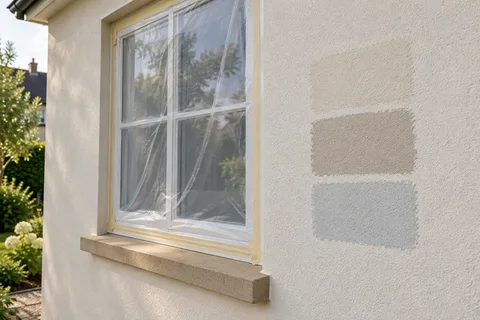
On a single wall the coating is often rolled or brushed rather than sprayed, because there is less to cover and overspray has more nearby to land on: windows, a car on the drive, the neighbour's wall on a semi. Everything that is not being coated is masked. Each coating has its own weather rules, so read them; K Rend, to take one maker, will not have its thin coats applied below 5C or onto a wet or frozen wall.
Find and fix the cause of any staining: sill, bracket, gutter or path.
Kill off any algae, then wash the face gently, starting at the top.
Fill small cracks and holes; cut out and patch any hollow render.
Mask windows, sills, downpipes and neighbouring surfaces.
Apply primer where the product calls for it, then coat the full face.
Unmask and check the wall in daylight from where it is normally seen.
The right coating for the render underneath
A painted sand-and-cement wall takes another coat of masonry paint that suits the existing one, once flaking paint has been scraped off. Scraped render with the colour mixed through it, as most monocouche is, should not simply be painted: K Rend's FAQ tells owners to wash its coloured renders instead, since paint robs them of water repellency and breathability, and the firm sells Colour Enhance specifically to refresh old scraped render. A lime-rendered wall takes limewash; SPAB warns that modern paints can trap moisture in old solid walls.
Where the new colour stops
Decide the edge before you start. An external corner is the natural place to stop, because the light changes there and a slight difference between the recoated wall and the next one is hard to see. Stopping halfway along a face, for example at a downpipe, works only if the line is straight and the downpipe stays. On a semi-detached house the colour has to stop at the party line, so pick a shade that sits comfortably next to your neighbour's half.
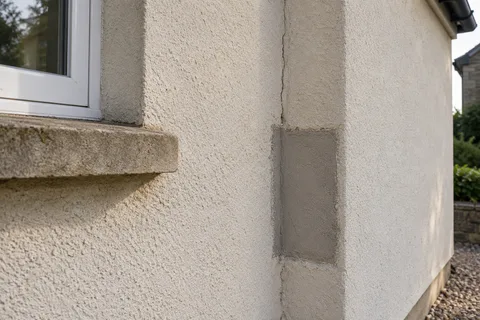
You can match the rest of the house or choose a contrast. Matching a weathered colour exactly is difficult, so look at a sample on the wall itself, in the light it normally gets, before the whole face is coated. If the result needs to be completely uniform, the honest answer may be to recoat the adjoining walls too.
Common questions
Should a stained wall always be resprayed?
No. Many stains wash off, and many come back because of a sill, bracket or gutter. Clean the wall, fix the cause, and recoat only if the colour is still wrong.
Can monocouche be painted?
K Rend tells owners of its coloured renders to wash rather than paint them, and sells a separate coating for refreshing scraped render. Check the original maker's guidance for your wall.
See housing and planning information for Sheffield and nearby places, including the source and geography behind each figure.