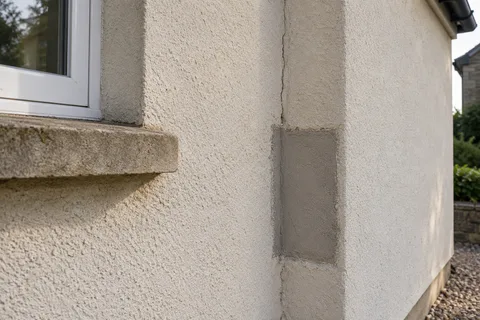
Monocouche, one wall
Monocouche Render Sheffield: One Elevation or an Extension
Monocouche is a single thick coat of pre-coloured render, scraped once it has stiffened to leave a matt, slightly open surface. Because the colour runs all the way through, it needs no paint. As a single-wall job it most often appears on a new blockwork extension, a rebuilt gable or one elevation being brought up to date. Its thickness and its scraped finish make the joins with the rest of the house the part to plan.

On this page
The usual job: a new extension wall
New blockwork is the background monocouche was designed for. K Rend's K Mono is meant for blockwork of moderate to low strength. It goes on at 17-18 mm in a single pass, is ruled level, and then waits anywhere from 3 hours to a day, depending on how fast the wall and weather dry it, before being scraped down to about 16 mm. Around window reveals and at quoins it may be left smooth to give a clean frame, though K Rend warns against polishing the face.
On an extension, the render usually wraps the new walls and stops where they meet the original house. If the old house is bare brick or stone, the new render stands about 16 mm proud of it, so the edge needs a stop bead and a clean vertical line. If the old house is already rendered, the extension can either finish at a bead at the junction or be matched across it, which is harder than it sounds.
Check the blockwork is complete and the openings, sills and lintels are in.
Fix a bellcast bead at the damp-proof course, angle beads and a stop bead at the house junction.
Spray or trowel the render on in a single pass and straighten it with a rule.
Wait for it to firm up, then scrape the entire wall while it is still inside the scraping window.
Finish reveals and quoins, refit any fittings and keep the base clear of soil.
- Background Usually blockwork or brick; uneven or mixed walls may need a levelling coat.
- Beads and mesh Beads at corners, reveals and the base; mesh over junctions and lintels.
- Monocouche passes One through-coloured material, applied in passes to the specified thickness.
- Scraped surface Scraped once partly set, which removes the skin and leaves the texture.
Wall on the left, finish on the right. Not to scale: coats, thicknesses and primers follow the chosen manufacturer’s system and the condition of the wall.
Where the extension meets the house
The junction between new and old masonry is a likely line for cracks, because the two can move differently as the new work settles and dries. A render coat running continuously across it tends to crack along that line. A bead or a deliberate joint at the junction lets the render break where it is designed to, rather than wherever it chooses.
At the top, the render stops under the eaves or against the roof of a single-storey extension with a neat bead line. At the base, a bellcast bead sits at damp-proof course level; Catnic's data sheet for its PVCu bead describes the drip as throwing rainwater clear of the wall beneath and lists it for render 10-16 mm thick, so check the bead chosen suits a monocouche of this thickness.
Matching a monocouche wall to existing monocouche
If the house already has monocouche, find out the product and colour if you can. Even then, the existing wall has weathered and the new one has not, so the same colour reads lighter or cleaner at first. The scrape matters too: scraping at a different point in the set changes how open the texture looks. Seeing a scraped sample beside the old wall, not just a colour card, is the only fair test.
When the difference is too obvious, K Rend's product guide lists Colour Enhance, a coating designed to refresh the appearance of existing scraped render, which can bring old and new faces to one colour once the new wall has cured. That is a respray rather than a re-render.
Damage and repairs to a monocouche wall
With the colour running all the way through, a small chip reveals more of the same shade, and K Rend sells a tinted exterior filler, Colour Fill, for minor damage. Larger damage is cut back to sound render and reapplied, then scraped; even a well-made patch tends to show, because it is scraped at a different time from the wall around it. Taking the repair to a natural break, such as a window edge or a corner, hides it best.
For upkeep, K Rend's FAQ recommends washing its through-coloured renders rather than painting them, because paint removes their water repellency and breathability. For cleaning, its maintenance page recommends a gentle fan-pattern wash working downwards, with an algae treatment on any damp face that has gone green.
Common questions
Is monocouche suitable for a new extension?
It is a common choice for new blockwork. K Rend describes K Mono for moderate to low strength block, applied in one pass and scraped to about 16 mm.
Can the extension match the house's old monocouche?
It can come close, but weathering and the timing of the scrape both affect the look. View a scraped sample beside the old wall, and consider a coating over both if they must match.
See housing and planning information for Sheffield and nearby places, including the source and geography behind each figure.