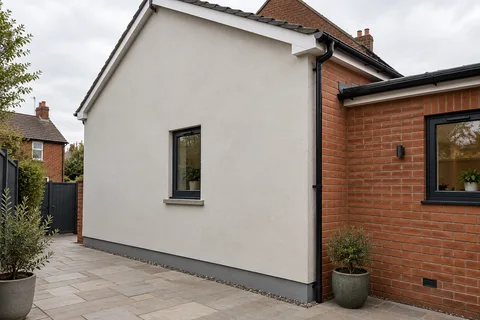
From one wall to the house
House Rendering Sheffield: When One Wall Becomes the House
Most render enquiries start with one wall. Sometimes, once that wall is looked at properly, the honest answer is that the rest of the house is heading the same way. This page is about that decision: the signs that a single-wall problem is really a whole-house one, what changes if the job grows, and the good reasons for keeping it to one wall.

On this page
Signs the problem is not confined to one wall
The clearest sign is sound. If the failing gable sounds hollow when tapped and the front and rear sound hollow in places too, the render is losing its bond across the house, not just where it shows. The Building Conservation Directory's guidance on render repairs describes tapping to trace detached areas; on a survey of the whole house, those areas are marked on each elevation so you can see the pattern.
Other signs are repetition and age. The same crack running from the corner of every window points to the same cause on every face. Render of the same type and age on all walls will usually fail in the same way, just more slowly on the sheltered sides. Previous patch repairs failing at their edges on several walls suggest the coat around them is going too.
- Scaffold and protection Windows, doors, paths and planting are covered; downpipes, lights and satellite brackets come off.
- Old finish tested or removed Failed render is removed; the survey decides whether any sound areas can remain within the specified system.
- Masonry repairs and beads Cracked bricks and open joints are repaired; corner, stop and base beads are fixed.
- Base coats Sand-and-cement scratch and float coats, or a manufacturer basecoat with mesh.
- Finish coat A painted, scraped or thin-coat coloured finish, applied in suitable weather.
- Fittings and junctions Fittings are refixed through the new surface; sills, roofline and abutments are sealed.
The usual order of work. The survey and the chosen products decide the actual steps.
What changes if the job grows
A whole-house job is a different project, not a bigger version of a single wall. Scaffold goes round the house, and if any of it stands on the pavement, Sheffield City Council requires the scaffolding company to hold a permit to occupy the highway. The programme runs over weeks rather than days, because each face is stripped, repaired and rendered in turn and the finish coat on each face has to be completed in one pass.
The rules change too. Building control's guidance shifts as well. Under Approved Document L, new external render counts as renovation, and when it covers over a quarter of the outside of the house the walls should be brought up towards 0.30 W/m²K, so long as that is practical and pays back within 15 years. That can bring external wall insulation into the conversation. Where the house is in a conservation area or the National Park, rendering it all over is not something householder permitted development allows, so the planners need to see a change of finish first.
Doing one wall now and the rest later
There is a middle way. The worst wall can be re-rendered now, in the system and colour chosen for the whole house, with the rest following when they need it. The first wall then ends at corners, where the later work can join it at a bead, and its details are recorded for the next renderer: products, colour, what was stripped and where the beads are.
The catch is weathering. The first wall gets a head start on the weather, so it can look a shade different from the later ones until they catch up. Joins at corners hide most of that.
Have every elevation sounded and marked, not just the wall that prompted the enquiry.
Separate what must be done now from what can wait.
Settle the system and colour for every wall before the first one starts.
Re-render the worst wall first, stopping at corners with beads.
Note the products, colour and bead positions for whoever does the next wall.
Good reasons to keep it to one wall
A whole-house job is not automatically the better one. If the other walls sound solid, look sound and have no repeating cracks, re-rendering them replaces good render for the sake of appearance. An exposed gable often fails decades before a sheltered front. Keeping the job to that wall, and recoating the others if the colours no longer sit together, is a legitimate result; the single-wall page covers how it is done.
It is also worth separating what is broken from what is merely dated. A sound wall in a colour you dislike needs a coating, not new render. Ask for the survey to say, wall by wall, which faces have failed and which simply look tired.
Common questions
When should a single-wall enquiry become a whole-house survey?
When tapping finds hollow areas on more than one face, when the same cracks repeat at every opening, or when other planned work such as new windows or insulation affects every wall.
Is it better to do the whole house at once?
It depends on the house. Doing it together means one scaffold instead of two and one finish all round, but it also replaces render that may have years left in it. Compare the condition of each wall first.
See housing and planning information for Sheffield and nearby places, including the source and geography behind each figure.