Patching Textured Render: Matching Grain, Scrape and Colour
Patching Textured Render: Matching Grain, Scrape and Colour
A render patch is judged from the street, not by how well it is bonded. A perfectly sound repair can still stand out if its texture is finer, its grain smaller or its colour fresher than the wall around it. Matching starts with knowing what kind of render the wall has, because a scraped monocouche, a thin-coat finish and a dashed wall are each patched in a different way.

On this page
Identify the finish before trying to match it
Look at the surface closely in low, raking light. A scraped finish has a soft, open texture with small pits where the scraping tool has dragged grains out; it is typical of through-coloured one-coat renders. A thin-coat finish is flatter, with an even scatter of grains of one size. Dry dash has small stones pressed into a receiver coat, while roughcast has them mixed into the wet render and thrown on. A painted sand-and-cement wall has a uniform paint film over a floated or textured surface.
Each finish dictates how the patch is built. A scraped monocouche such as K Mono is applied in one pass to about 17-18 mm and scraped back to a nominal 16 mm once it has set, which K Rend puts at between 3 and 24 hours depending on the background and drying conditions. The scraping creates the texture, so a patch has to be scraped at the same stage of set and with a similar tool, or it will look smoother or coarser than the wall.
A thin-coat finish is matched by grain size. K Rend's Silicone TC comes in grades named after their largest grain, 1.5 mm and 3.0 mm, and is applied to the thickness of that grain over a primer. A patch in the wrong grade reads as a different surface even in the right colour, so the existing grain is checked before anything is ordered.
Dashed walls are the hardest to patch invisibly, because new stones are clean and old ones are weathered. K Rend's product guide lists an overcoating dash receiver designed for refurbishing existing dry dash without a base coat, which allows a patched dash wall to be given one new dashed surface instead of carrying a visible repair.

| Finish | What must match | Typical giveaway |
|---|---|---|
| Scraped monocouche | Timing of the scrape and the tool used | Patch smoother or coarser than the wall |
| Thin-coat finish | Grain grade and the float pattern | Different sparkle in raking light |
| Dry dash | Stone size, colour and density | Clean stones beside weathered ones |
| Painted render | Underlying texture, then the paint | Smooth patch showing through new paint |
Where the patch should stop
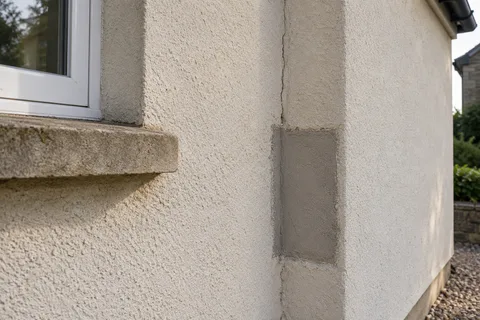
A patch that stops in the middle of a face with a ragged outline is the most visible kind. One cut to a straight-sided shape is less obvious, and one taken to a natural break such as a corner, a bead, a downpipe or the edge of a window is the least obvious of all. K Rend's Silicone TC data sheet asks for work to a wet edge and for continuous surfaces to be finished without interruption, which is why a thin coat is taken to a break rather than feathered into old material.
That can make the finished area bigger than the damage. For example, in a hypothetical case with a fist-sized hole in a thin-coat wall about two metres from a corner, the choices are a neat rectangle round the hole, accepted as a visible repair, or a new finish coat carried across to the corner so the join falls where the wall turns. The second takes more material and time, but it puts the join where the eye already expects a change.
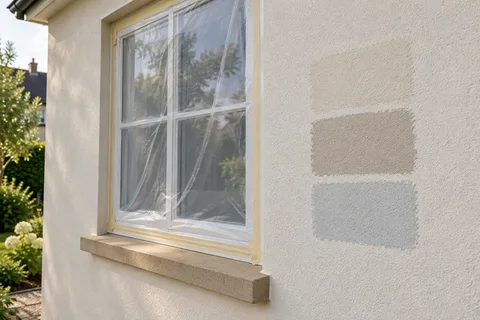
Size on its own does not hide anything, though. A large area of fresh render can be more noticeable than a small one if the colour difference is strong. Deciding between the two is easier after a small trial on the wall itself, which K Rend recommends as a test panel for its silicone finish, viewed from wherever the wall is normally seen.
Colour, weathering and timing
Through-coloured render looks different when it is new. It is cleaner than render that has carried a film of dirt and organic growth for years, which K Rend's maintenance guidance describes as natural weathering. Even an exact colour reference will look brighter in a fresh patch, and the gap closes only as the patch itself weathers.
Cleaning the old wall first makes the comparison fairer. K Rend's guidance is a pressure washer on a fan setting rather than full power, working from the top down with a mild detergent, and a biocide where algae has taken hold. A sample matched against a dirty wall can look wrong in the other direction once the wall has been washed.
Small defects in a sound scraped wall do not always need new render at all. K Rend's Colour Fill is a flexible exterior filler for small cracks and holes, made in colours to match its renders. For a scatter of small chips, filling in a matching colour can be less visible than several patches cut out and rebuilt in full.
When a coating is the better answer
If the patch still stands out once it has weathered, or the wall carries several repairs of different ages, a coating over the whole face gives a single colour. K Rend makes Colour Enhance for exactly this, a coating designed to refresh existing scraped render, and masonry paints do the same job on sand-and-cement render. A respray of that kind evens out colour but not texture, so a smooth patch in a rough wall will still show when the light is low.
Coating comes after the repair, not instead of it. The patch needs the same curing time as any new render before anything goes over it, and the existing finish has to be clean and sound. The render repair guide covers that first stage; the coating is a separate decision made once you have seen how the patch looks.
Keep the product name, grade and colour reference of whatever went onto the wall. The next repair, whether it comes in five years or twenty, is far easier to match when someone knows what the wall is. The Sheffield wall-rendering homepage links to each of the finishes mentioned here.
Common questions
Should I patch now or wait until the whole wall needs work?
Patch now if the damaged area is hollow, cracked through or letting water in, because water behind render can loosen more of it and the repair grows. If the problem is only appearance, such as an old patch that never matched, waiting is reasonable: the wall can be recoated or refinished as one face later, and the patch then disappears under a single colour. Whichever you choose, ask for the existing finish to be identified first, so that any later work starts from a known grain, texture and colour.
See housing and planning information for Sheffield and nearby places, including the source and geography behind each figure.