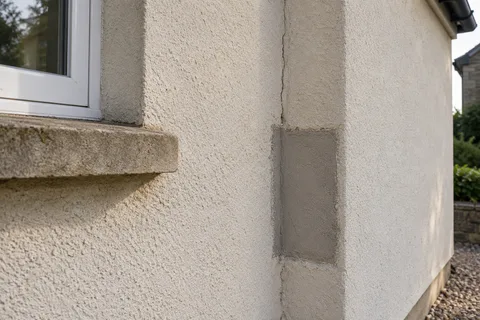
Stained Rendered Walls: Causes, Cleaning and Recoating
Stained Rendered Walls: Causes, Cleaning and Recoating
Most stains on render are water made visible. Green and black growth marks where a wall stays damp, orange streaks run from rusting metal, white bloom comes out of the wall itself, and dirty streaks trace the path rain takes off sills and copings. Painting over any of them without dealing with the water can bring the stain back through, or beside, the new coat.

On this page
Reading the stain
Green, grey-green or black patches are usually algae or other organic growth. K Rend's maintenance guidance explains that algae grows on surfaces that stay damp for long periods, and that walls near woodland are more prone to it. On a single wall, look for whatever keeps that face wet: shade from trees or a neighbouring building, little direct sun, or a leaking gutter or overflow above.
Orange or brown streaks running down from a point are usually rust. K Rend lists satellite brackets, hanging-basket brackets, light fittings and vents among the fixings that stain render, and recommends stainless steel, noting that cheap brackets can begin to stain once their paint flakes.
Vertical dirty streaks beneath sills, at sill ends and below copings show where rain runs off a projection and down the render instead of dripping clear. Ibstock’s 2025 note gives a minimum 40 mm drip clearance in NHBC cast-stone details for qualifying registered new homes, and explains how sill extensions beyond reveals help shed water. On this wall, trace the runoff before choosing the repair; the historical detail does not establish the cause of a stain. A dark band along the bottom of the wall is often splash from a hard path, the problem described in the RICS guide on bridged damp-proof courses.
White, powdery or crystalline deposits are salts carried out of the masonry as it dries. SPAB notes that a new lime render can draw salts out of an old wall at first. On a lime-rendered wall that bloom is a sign of the wall drying out through its render, and it is not something to seal in under a dense coating.


| Stain | Likely cause | First step |
|---|---|---|
| Green or black patches | Algae on a face that stays damp | Biocide and a gentle wash; find the damp source |
| Orange streaks from a point | A rusting bracket or fixing | Replace it with stainless steel, then clean |
| Streaks under sills and copings | Water running off without a clear drip | Check the drips and the sill ends |
| Dark band at the base | Splash-back or a bridged DPC | Check the ground level and base detail |
| White powdery bloom | Salts coming out as the wall dries | Let it dry out; avoid sealing it in |
| Stain following a crack | Water getting into the render | Repair the render before any coating |
Clean first, then judge
K Rend's advice for cleaning its renders is a pressure washer set to a fan spray, not high power, working from the top down with clean water and a low concentration of mild detergent; a high-pressure jet can damage the surface. Where algae is established, a biocide or algaecide goes on first. K Rend's Algae Clean is one such water-based fungicidal wash, sold for render, brick, concrete and paving.
Cleaning also shows how deep the problem goes. A stain that washes off and stays off for a season was sitting on the surface. One that returns quickly in the same place points to a water source that is still active, and one that will not shift at all may be in the render or its coating rather than on it.
Try any method on a small, out-of-the-way area first. Household bleach and strong cleaners are not made for coloured render, and old paint films can react in ways nobody predicted, so a trial patch shows what a method does before the whole face is treated. Leave the trial area through a spell of wet weather if you can, because that is when growth and streaks reappear.
Fixing the cause
Many causes are small jobs. A dripping overflow or a leaking gutter joint is repaired. Rusting brackets are swapped for stainless ones. A sill without a drip, or one cut flush with the reveal, can be replaced or extended. Soil heaped against the base is pulled back so that the render stops clear of the ground.
Some causes are render defects. A stain that follows a crack, or spreads from an area that sounds hollow, is water getting into and behind the render, and it needs a render repair before any colour goes on. A coating cannot keep water out of a crack that is still moving, and it can slow the drying of the wet render behind it.
On older solid walls the coating itself can be the cause. SPAB explains that impervious cement render on an old wall restricts evaporation, so water that gets in stays in, and it recommends limewash rather than modern paint as usually the most suitable finish for those walls. A wall that has darkened and blistered under a dense paint is not helped by another coat of the same paint.
For example, on a hypothetical rear wall that faces away from the sun beside a row of trees, green growth spreading up from the base, grey streaks under both sills and an orange run beneath an old satellite bracket would be three separate problems. The growth needs biocide, a gentle wash and the soil pulled back from the base; the streaks point to sills without adequate drips; the run needs a stainless bracket. A coat of paint would hide all three for a while and fix none of them.
Choosing a coating once the wall is ready
With the cause dealt with and the wall clean and dry, a coating can even out the colour. The choice follows the surface underneath. K Rend describes its silicone masonry paint as made with silicone resin and mineral fillers for water repellence, one route on sound cement or polymer render. For lime, a mineral paint or limewash keeps the wall able to dry; K Rend makes a mineral paint for its lime range.
A respray normally covers the whole face, or runs to a natural break such as a corner, because a coated patch shows as clearly as the stain it replaced. Ask for a test area first, viewed in the light the wall normally gets. If you are choosing a new thin-coat finish rather than paint, K Rend's Silicone TC contains a biocide, which is relevant on a shaded face.
Shade and damp do not go away when the wall is recoated, so a gentle clean every so often stays part of looking after that face. Note the product and colour so that later touch-ups match. The Sheffield wall rendering homepage links to the respray, repair and lime guides that follow from what the stain tells you.
Common questions
Can I paint straight over algae or mould on render?
No. A coating needs a clean, sound surface to bond to, and living growth under paint can come back through it. Treat the growth with a biocide, wash the wall gently from the top down and let it dry. Then watch whether the stain returns in the same place over the next spell of wet weather. If it does, look for the water source first; if it does not, the wall is ready for whichever coating suits its surface.
See housing and planning information for Sheffield and nearby places, including the source and geography behind each figure.