Commercial walls
Commercial Wall Rendering and Repairs in Sheffield
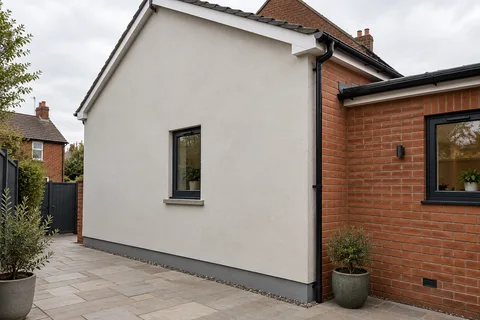
Commercial rendering is often a single wall: the side return of a corner shop, the gable of a pub, the frontage of a small industrial unit or the wall around a yard. The work is the same as on a house wall, cutting back, repairing, rendering or recoating, but the wall is in public view, often next to the pavement, and the business needs to keep trading while it is done.

On this page
Typical one-wall commercial jobs
The common jobs are repairs and refreshes. Old signs, lights and alarm boxes leave holes, rust runs and patches when they come off. Shop returns facing the weather crack and hollow like any gable. Yard walls get knocked by vehicles. A frontage may simply need a new colour for a new business.
Each of these follows the usual sequence. Hollow areas are found by tapping, cut back to a firm edge and rebuilt in matching coats; holes from fixings are filled; a faded wall is cleaned and recoated. The repairs page and the respray page describe the methods in more detail.
Look at why the wall failed before deciding on the fix. A shop return that faces the prevailing weather, a gable under a blocked parapet gutter or a yard wall with soil banked against its base will keep breaking down whatever render goes on, unless the water source is dealt with. On a commercial building, gutters, parapets and flashings may belong to a landlord or a managing agent, so agree who fixes them before the render work is booked.
- Background and drawings Blockwork, board or existing façade checked against the specification.
- Set-out Beads, movement joints and bay breaks marked from the drawings.
- Basecoat and mesh Mesh across board joints, openings and changes of background.
- Finish in bays Each bay is finished in one go so day-joints do not show.
- Inspection and handover Hold points and the installed products are recorded.
The usual order of work. The survey and the chosen products decide the actual steps.
Access next to the public
Many commercial walls stand on or beside the pavement. Scaffolding or hoarding on the road or footway needs the council's highway occupation permit. The scaffolder makes the application, giving a location plan, and the permit is tied to that spot and those dates. Smaller jobs may use a tower or a mobile platform, but the public still has to be kept clear of falling debris and wet render.
Plan around trading. Stripping and drilling are noisy and dusty, so they are often done early or when the premises are closed, and entrances, fire exits and deliveries have to stay usable. Sheeting on the scaffold protects passers-by and the fresh render.
Agree working hours, entrances and delivery routes that must stay open.
Book the scaffold or tower, plus a highway permit if it will stand on the footway.
Remove signs, lights and brackets; record their positions.
Repair, re-render or recoat the wall in the usual sequence.
Refix signage on stainless brackets with fixings suited to the render.
Hand over the product names and colours for future repairs.
Systems for a commercial wall
A new or stripped commercial wall usually takes monocouche or a thin-coat silicone. A monocouche such as K Rend's K Mono, laid on in a single thick coat and scraped back to roughly 16 mm, suits a new blockwork unit, while a thin silicone such as its Silicone TC needs a meshed levelling coat underneath because the finish itself is only grain-deep. On a large single wall, either has to be finished in panels that can be completed in one session, with joins at corners, openings or beads.
Signage is the commercial wall's particular problem. K Rend's maintenance notes recommend stainless brackets, because ordinary painted brackets can rust and stain the render, and warn that ladders and scaffold resting on the face can mark it. Every fixing through render is also a route for water if it is not sealed.
A small commercial wall also needs the same base details as a house. Render should stop above the damp-proof course on a bead, not run down into the pavement, and the RICS consumer guide on bridged DPCs explains why: a bridge lets ground moisture past the barrier, and rain splashing off hard paving wets the bottom of the wall.
Planning for shops, offices and flats
The council's conservation-area page points out that shops, offices and flats lack the permitted development rights a house has, so altering the outside of one is more likely to need an application. In a conservation area, a change of finish or a new colour on a prominent frontage should be checked with the council before work is ordered. Like-for-like repairs are the least likely to raise questions.
After the work, the business should keep the product names, colours and a photo of the finished wall, so the next repair or new sign starts from known materials.
Common questions
Do I need a permit for scaffolding outside my shop?
Yes, if it stands on the footway or road. The scaffolder applies to the council for a highway occupation permit covering that position and those dates.
Can a shop wall be repaired without closing?
Usually, with the noisy stages planned for quiet hours and entrances kept clear. Access and protection for the public come first.
See housing and planning information for Sheffield and nearby places, including the source and geography behind each figure.